
When Should You Get a Second Opinion on a Scan?
A second opinion is not a sign of distrust - it is a recognised and entirely reasonable part of good medical care. We explain the circumstances in which an independent specialist review can provide clarity, reassurance or meaningfully better outcomes, and what the published evidence tells us about how often radiologists disagree.
Doctorum Radiologists
Published May 2026
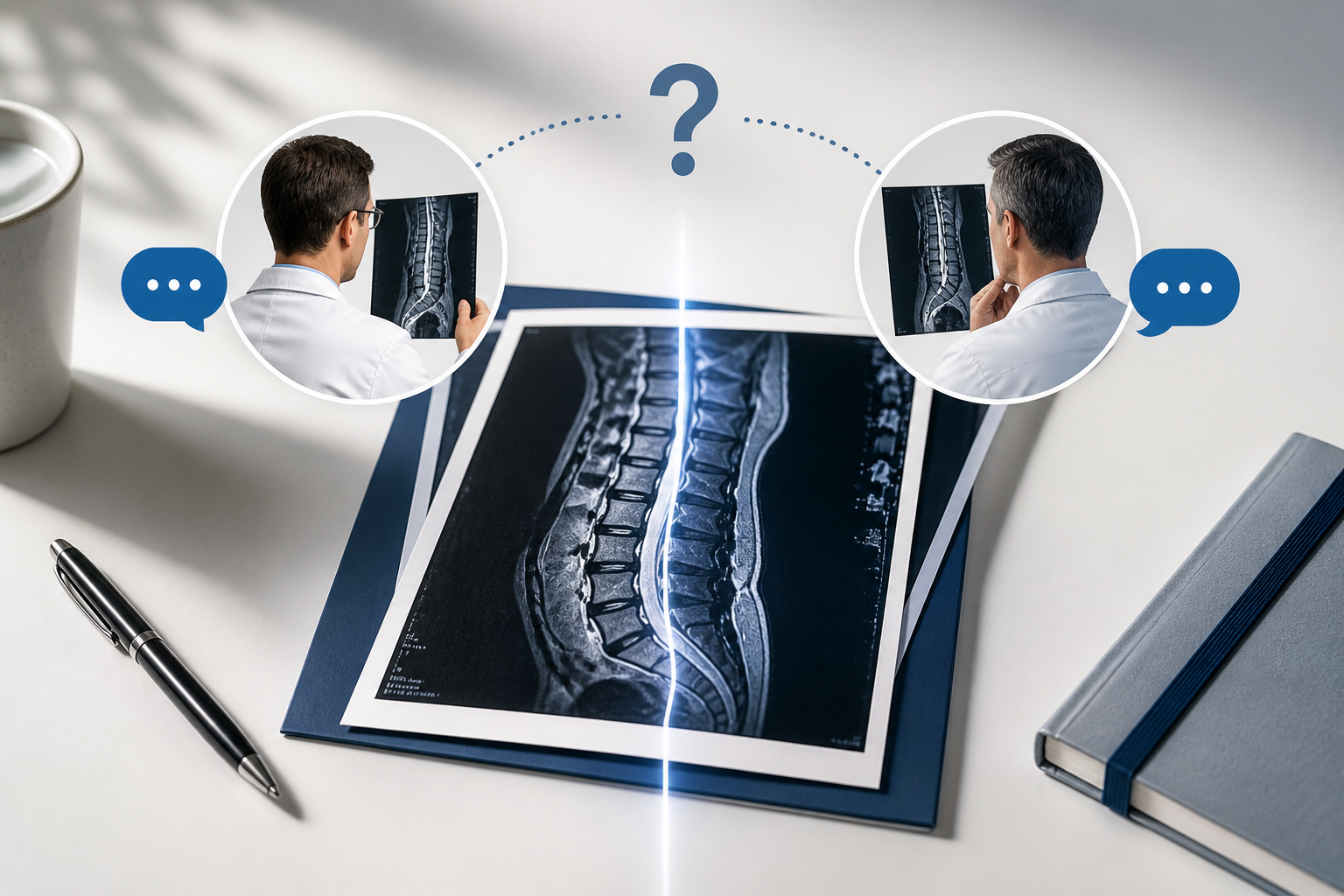
Most people associate the idea of a second opinion with the most serious of medical situations - a cancer diagnosis, a planned operation, or a finding that has come as a shock. In reality, a second opinion on a radiology report is useful in a much wider range of circumstances, including some that may not feel particularly dramatic at the time.
Radiology is both a science and a skill. The same set of images reviewed by two equally qualified radiologists can yield subtly different interpretations - not because one is wrong, but because medical imaging involves judgement, pattern recognition and clinical context, all of which can vary. Understanding when that variation matters is the starting point for deciding whether an independent review is worth seeking.
What Does the Evidence Show?
The published data on radiology discordance - the rate at which two radiologists reviewing the same images reach different conclusions - is more significant than many patients realise.
54%
of specialist cancer MRI studies showed discordance when reviewed by a subspecialist second opinion
1 in 10
NHS imaging departments in the UK conduct formal quality assurance peer review of radiology reports
26%
of patients who had outside ultrasound studies re-read by a subspecialist had their management changed
A 2025 study published in European Radiology reviewed 461 rectal MRI studies and found discordance between the original and subspecialist second-opinion report in 53.8% of cases. Of those discordant cases, more than half were classified as major discordances - meaning they had a direct bearing on clinical decision-making. Second-opinion reports led to changes in surgical planning in up to 46% of affected patients, and surgeons rated subspecialist second-opinion reports significantly more useful than the originals.
A 2023 study published in Abdominal Radiology found that when outside ultrasound studies were reviewed by subspecialist radiologists, discrepancies were identified in 37.8% of cases. In 26% of cases, the subspecialist recommended a change in clinical management. These are not rare edge cases - they represent a meaningful proportion of everyday imaging.
Closer to home, a 2025 audit published in Clinical Radiology found that only 10% of NHS imaging departments in England, Scotland, Wales and Northern Ireland conduct formal quality assurance peer review of radiology reports. The remaining 90% rely on informal processes only - a finding the authors describe as suboptimal. Independent second opinions therefore serve an important role in quality assurance that the system itself does not routinely provide.
It is important to note that not all discrepancies represent errors. Some reflect legitimate differences in interpretation, updated clinical context, or the benefit of subspecialty expertise applied to a complex study. A second opinion does not imply the original report was negligent - it simply brings an additional expert perspective.
"Seeking a second opinion is not a challenge to your clinician's judgement. It is an informed, proactive step - one that experienced doctors routinely take on behalf of their own patients."
Doctorum Consultant Radiologist
Six Situations Where a Second Opinion Is Worth Considering
There is no single rule. The following scenarios represent the most common circumstances in which patients find independent radiology review genuinely useful.
Your scan has been reported as normal, but your symptoms persist
A normal report does not always mean nothing is wrong. It may mean the abnormality was not visible on that modality, was present but subtle, or was outside the area of focus. If your symptoms remain unexplained after a normal scan, a subspecialist review - or an opinion on whether a different type of scan is warranted - can be a useful next step.
The report uses uncertain or non-committal language
Phrases such as "indeterminate finding," "cannot exclude," "clinical correlation is advised" or "recommend further imaging" are common in radiology reports. They reflect genuine uncertainty. In these situations, a subspecialist second opinion can often provide a more definitive view or clarify whether further investigation is genuinely necessary.
You have received a significant or unexpected diagnosis
If imaging has identified a serious finding - a suspected tumour, a structural abnormality, or evidence of a significant condition - an independent review before committing to treatment is a well-established part of good oncological and surgical care. A 2025 study in European Radiology found that subspecialist second-opinion review of cancer staging MRI changed surgical planning in up to 46% of cases where a major discordance was identified. The authors concluded that formalised second-opinion pathways should be standard in oncological care.
Your scan was reported by a generalist rather than a subspecialist
All consultant radiologists are broadly trained, but most also develop subspecialty expertise in particular areas - neuroradiology, musculoskeletal, breast, oncological imaging and so on. A 2025 systematic review in the European Journal of Radiology, covering 11,186 musculoskeletal imaging examinations across eight studies, found clinically significant discrepancies in every single study when non-specialist reads were reviewed by MSK subspecialists - with rates particularly high in oncological, fracture and multiple myeloma cases. The review concluded that formalised subspecialist second-opinion pathways are warranted.
You are facing a major treatment decision based on imaging findings
Surgery, chemotherapy, radiotherapy or other significant interventions are sometimes recommended on the basis of scan findings. Before agreeing to any major procedure, it is reasonable - and in many specialist centres, routine - to have the imaging reviewed independently. This is not about second-guessing your clinical team; it is about making sure the information underpinning the decision is as accurate as possible.
You simply want reassurance
Not every second opinion is driven by concern about accuracy. Some patients find that having an independent consultant confirm the original findings provides genuine peace of mind - particularly when the original report contained findings that were worrying to read, even if ultimately benign. Reassurance is a legitimate and valuable outcome in its own right.
What Does a Radiology Second Opinion Actually Involve?
A radiology second opinion means your scan images - the original DICOM files, not just the written report - are reviewed independently by a consultant radiologist who was not involved in the original interpretation. The reviewing radiologist produces a new, formal written report based on their own assessment of the images.
This is different from simply asking your GP to explain the existing report. It is a fresh clinical interpretation, carried out to the same standard as the original, by a doctor with relevant subspecialty expertise.
To proceed, you will need a copy of your scan images - usually available as a DICOM file transferred digitally or on a CD from the imaging centre where your scan was performed. If you are unsure how to obtain them, our guide explains the process step by step.
Does It Matter Which Radiologist Reviews Your Scan?
Yes - and this is one of the most important factors in the value a second opinion can provide. The evidence consistently shows that discrepancy rates and clinical impact are highest when a study is reviewed by a radiologist with direct subspecialty expertise in the relevant area. The 2025 MSK systematic review found clinically significant discrepancies in 100% of included studies when non-specialist reads were compared with subspecialist reviews - a finding that is difficult to ignore.
A separate 2023 UK NHS audit published in iRadiology found a significant discrepancy rate of 1.2% among consultant radiologists reviewing acute and emergency CT scans on weekend on-call shifts - demonstrating that even at consultant level, out-of-hours and cross-cover reporting carries a measurable risk. This underlines why an elective, subspecialist second opinion - carried out without time pressure and by a doctor who specialises in the relevant body area - provides a meaningfully different level of scrutiny.
When seeking an independent review, it is worth confirming that the reviewing radiologist has specific experience in the relevant area of your scan - a knee MRI reviewed by a musculoskeletal radiologist, a brain MRI reviewed by a neuroradiologist, and so on. This is standard practice at Doctorum, where every report is allocated to a consultant with directly relevant subspecialty expertise.
Will a Second Opinion Delay My Treatment?
This is one of the most common concerns patients raise - and in most circumstances the answer is no. A private radiology second opinion can be delivered within 24 to 48 hours of the images being received. In urgent situations, faster turnaround is often possible.
If a second opinion reveals a significant discrepancy, having that information early - before surgery, before staging is finalised, before a treatment pathway is set - is almost always clinically preferable to discovering it afterwards. In that sense, a timely second opinion can prevent delay, not cause it.
Considering a second opinion? Doctorum can help.
Our UK GMC-registered consultant radiologists provide independent second opinions on MRI, CT, ultrasound, mammography, X-ray and PET CT studies. Reports are delivered within 24-48 hours at a fixed price of £200, with no GP referral required. If you are not sure whether a second opinion is the right step for you, we are happy to discuss your situation first.
Find out about our second opinion serviceSources
- European Radiology (2025) - Added value and clinical impact of second-opinion subspecialist radiologist interpretations of baseline rectal MRI in patients with rectal cancer. DOI: 10.1007/s00330-025-12132-9
- European Journal of Radiology (2025) - The clinical value of second-opinion reporting by subspecialist musculoskeletal radiologists: a systematic review of 11,186 examinations. DOI: 10.1016/j.ejrad.2025.111981
- Clinical Radiology (2025) - Differential practice of peer review and peer feedback between NHS imaging departments and teleradiology companies. DOI: 10.1016/j.crad.2025.106919
- iRadiology / Wiley (2023) - Improving the quality and safety of radiology reporting: a prospective audit of discrepancies among consultant radiologists at a large NHS Trust. DOI: 10.1002/ird3.9
- Abdominal Radiology (2023) - Second-opinion interpretation of outside facility general ultrasound studies: rate of discrepancies and management change. DOI: 10.1007/s00261-023-03960-8
Related Articles
Understanding Your MRI Report: A Patient's Guide
We explain the structure of a radiology report, what the common terms mean, and what to do with your results.
Second OpinionsSecond Opinion Service
Independent specialist review of an existing scan report, delivered within 24-48 hours by a UK consultant radiologist.